A Morphemic Dictionary

I have long bemoaned the lack of a true, morphemic dictionary for Greenlandic, aimed at learners, rather than specialists. And eventually, I realised that if I ever wanted to see it appear, then I would have to make it myself. The result is MOFO, a Dictionary of Morphemic Forms, which is my personal collection of notes on morphemes. It is far from a complete dictionary, and it likely never will be. My focus has been on adding morphemes, that are interesting from the perspective of a learner, i.e. morphemes with special behaviour or special meaning, that you will need to know about, and which is rarely described in the normal dictionaries. In particular, the collection includes every affix that I have been able to find, with meticulous notes on sandhi behaviour, etymology and meaning.
MOFO fully supersedes my previous affix list. It contains every affix that my previous affix list did (and more), with much more elaborate explanations and error corrections, and it is continuously updated. It is also a searchable database, rather than a flat file, so it much easier to search and navigate than a pdf. I will keep the old pdf around for historical purposes (you can find it here), but henceforth, you should always use, and refer to, MOFO.
Also, if you are interested in contributing to the project, please get in contact with me, either through mail or Discord.
/Stian
What's new?
It is now two years (almost to the date!) since I published the first version (v1.0) of the Introduction to West Greenlandic.
Since then, I have received many questions, corrections and encouraging comments from interested readers, in particular from the community on the Inuit-Yupik-Unangan Discord server.
Some were incorporated into revisions of the v1-text, whilst others were added to my growing TODO-list for the next major version of the book.
And now, it is finally ready: The first version of the second edition (2ED) of the Introduction to West Greenlandic.
Thank you to all who have asked me questions and sent me corrections, or just an encouraging comment about the book being useful or helpful.
This book is for you.
An Introduction to West Greenlandic (grammar)
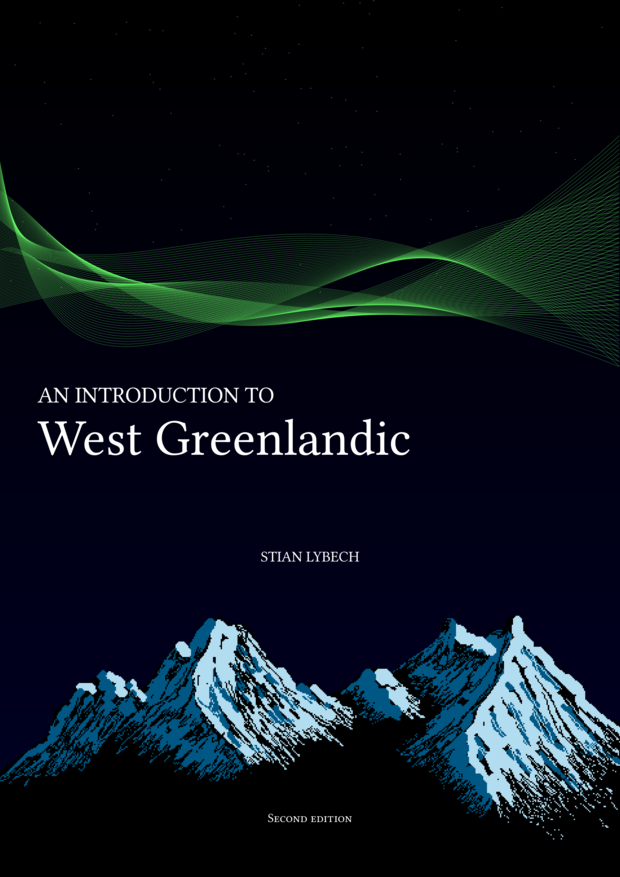
The Introduction to West Greenlandic (or AITWG for short) is my attempt to present the rules and regularities that pervade Greenlandic grammar, in a manner and style that should be accessible to anyone who has an interest in learning Greenlandic; i.e. no special knowledge of grammar or linguistics is required. It is not a book written only for the learned academics (although even learned academics may learn something from it); in other words, it is a book written for an audience of non-linguists and other ordinary people, who have an interest in the language of the Kalaallit.
The central thesis of the book is that Greenlandic is easy to learn, precisely because it is so regular that we can formulate a few, abstract rules for the behaviour of most words. Or rather word building blocks (called morphemes), because Greenlandic is a polysynthetic language where you constantly recombine bits of words to form new words during the process of speech. This makes Greenlandic wholly different from all the usual Indo-European languages like English, German, Spanish etc., and thus requires a different approach than you would use to learn any of these languages.
This is the second edition (2ED) of the book, with six new chapters on sentence construction, as well as numerous corrections and changes throughout the text, and several updated figures. This book should give you a solid foundation for understanding firstly how words are constructed (Part I); and secondly how these constructed words may then be used to build sentences (Part II). Lastly, Part III describes the grammatical systems of endings for nouns and verbs. Even they can be understood as composed of a much smaller set of building blocks, and knowing something of the underlying systematics can therefore greatly simplify your task of learning the many endings.